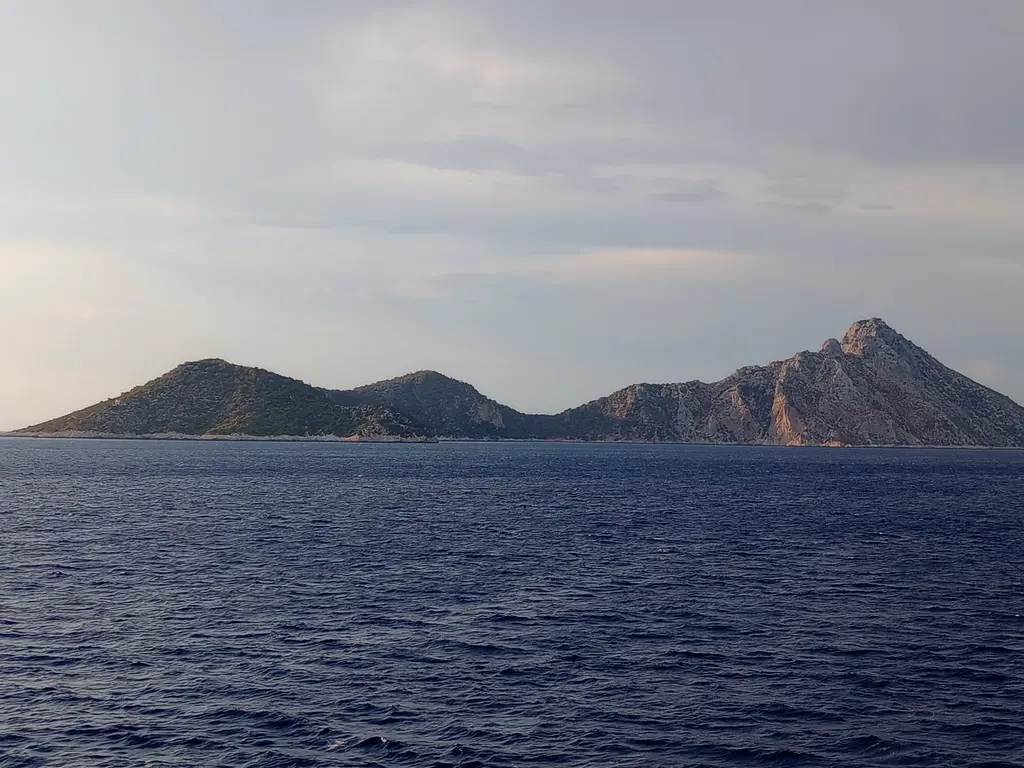
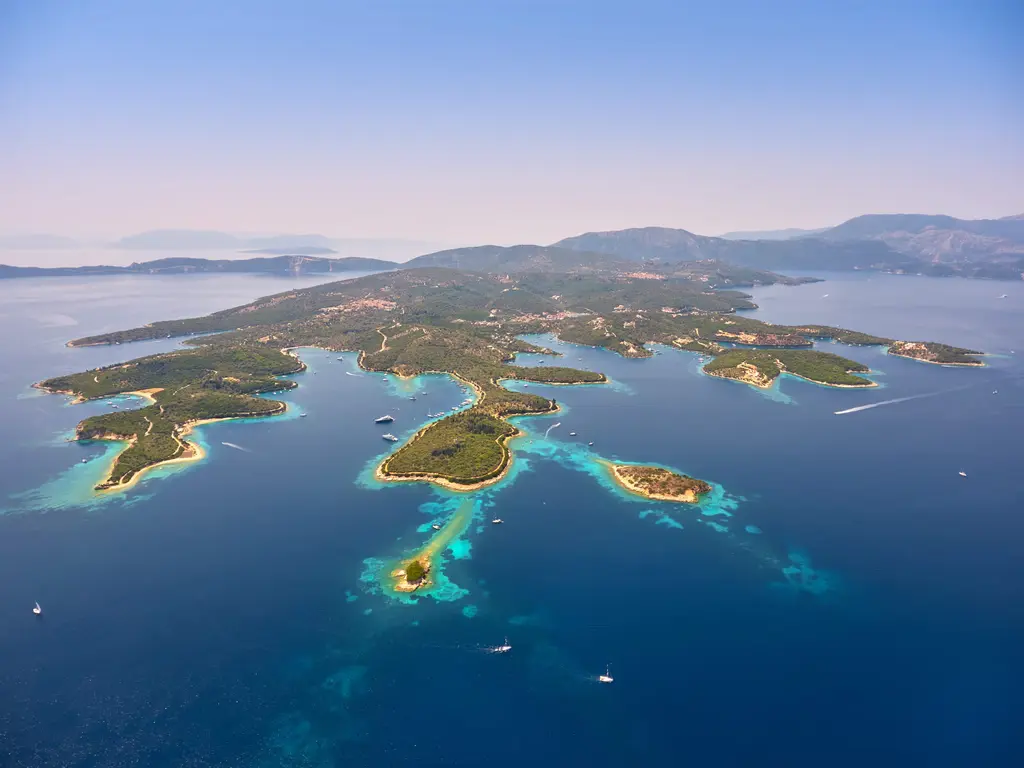
Homer's Sami
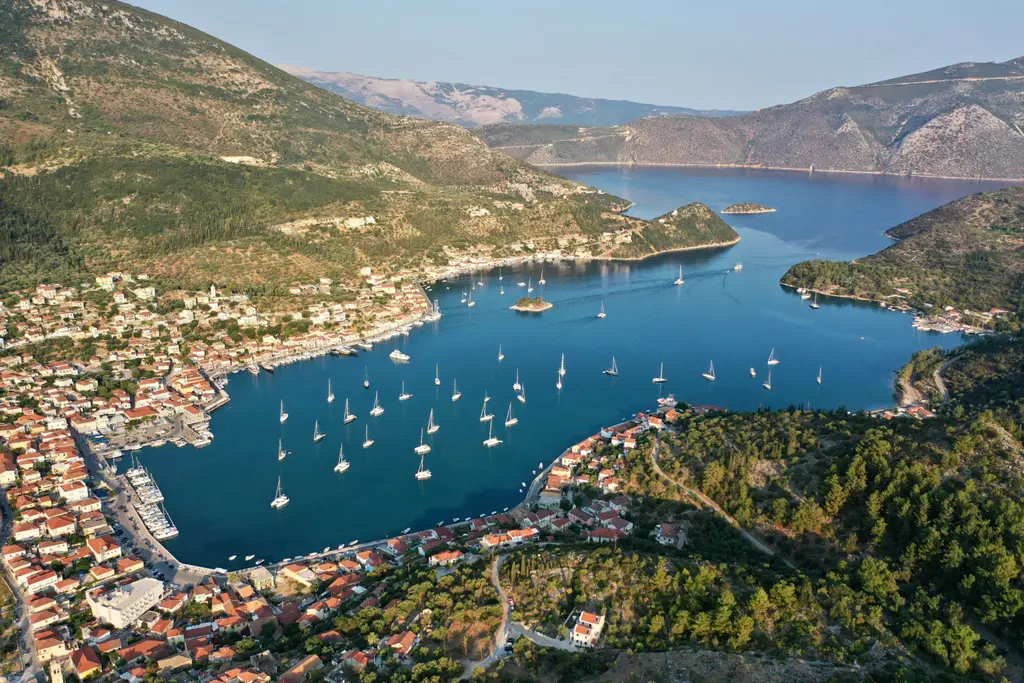
The identity of Homeric Sami (or Samos) is part of a broader re-evaluation of Homeric topography in the Ionian Sea, which suggests that the names of the islands shifted during the transition from the Mycenaean era to historical times.
What is the Island Today?
Based on a rational reading of the Homeric texts and a comparison with geographical data, the island corresponding to Homeric Sami or Samos is the present-day island of Ithaca. The island bears the name Ithaca in historical times, a name which, according to this analysis, belonged to modern Cephalonia during the Mycenaean period.
The geographical position of present-day Ithaca is designated as Island No. 2 in comparative analyses.
What is the Proposed Island?
The island proposed to be the Homeric Sami or Samos is the present-day island of Ithaca.
This identification is derived from the sequential listing of the islands of Odysseus's kingdom, which, when read in the context of the Mycenaean worldview (where South designates 'above' and North designates 'below'), places the islands in a specific order from south to north:
Dulichium (modern Zakynthos)
Sami (modern Ithaca)
Wooded Zakynthos (modern Lefkada)
In this sequence, the present-day island of Ithaca naturally falls into the place of Homeric Sami.
What is Written in Homer's Iliad and Odyssey About the Island?
Homeric Sami was one of the four large islands in Odysseus's kingdom.
Political Importance: Sami was mentioned as one of the significant islands in the territory of Odysseus. Twenty-four suitors for Penelope's hand originated from this island.
Family Connection: Odysseus had married his sister, Ctimene, to Eurylokhos, who was from Sami.
Stereotypical Reference: Sami is frequently mentioned in the fixed, stereotypical verse listing the islands: "Dulichion and Sami and wooded Zakynthos" [31, 203, 258, territory of Odysseus. Twenty-four suitors for Penelope's hand originated from this island.
Family Connection: Odysseus had married his sister, Ctimene, to Eurylokhos, who was from Sami.
Stereotypical Reference: Sami is frequently mentioned in the fixed, stereotypical verse listing the islands: "Dulichion and Sami and wooded Zakynthos".
Topographical Adjective: Sami is characterised by the adjective "paipalóessa", meaning mountainous, rocky, and multi-peaked.
How Do the Writings Match the Topography of the Island?
The geographical and geomorphological characteristics described for Homeric Sami align precisely with the topography of the modern island of Ithaca.
Paipalóessa (Mountainous/Rocky): The adjective paipalóessa characterizes rocky, mountainous, and multi-peaked islands. The name Samos itself derives from an ancient root (sama) meaning a place with high mountains. The present-day island of Ithaca is characterized by successive mountain peaks that traverse the entire island from end to end, making its landscape absolutely compatible with the description of paipalóessa Sami.
Geographical Position (Intermediate): The identification of Sami as the island geographically situated between Dulichium (Zakynthos) to the south and wooded Zakynthos (Lefkada) to the north is consistent with present-day Ithaca's location between modern Zakynthos and modern Lefkada.
Toponymic Evidence: The notion that the present-day Ithaca was the Homeric Sami is strongly reinforced by surviving toponyms:
The toponym Antisamos is located on the opposite eastern shores of Cephalonia, directly facing the southern part of present-day Ithaca. In ancient Greek toponymy (like Rio-Antirrio or Kythira-Antikythera), this suggests that the island opposite (modern Ithaca) was once called Samos.
The toponym Samiko still designates a broader area in the northern part of present-day Ithaca, preserving a linguistic link to the name Samos.
A Theory as to Why Its Name Changed
The geographical upheaval and the mismatch between Homeric names and modern island names in the Ionian Sea, including the switch of the name Sami to the modern Ithaca, is attributed to a "systematic cartographic reorganization" that occurred after the collapse of the Mycenaean world during the Dark Ages.
Corinthian Appropriation of Myth: The key factor in the renaming was the political and commercial interests of Corinth. The Corinthians, seeking to establish control over the navigation routes in the Cephalonian Strait, linked the mythical King Odysseus to their own ancestry (Sisyphus).
Name Migration: The name Ithaca, representing the lost glorious center of the Mycenaean world (which was then Cephalonia), was transferred to the neighboring smaller island, which was the Homeric Sami (modern Ithaca). This migration was encouraged by Corinthian interests to preserve the myth and the name of Odysseus's homeland on this specific island, which was tied to their alliance and where the Corinthian version of the Odysseus myth survived.
Loss of Samos Name: In the chaos of the Dark Ages, the name Samos largely relocated. Although its memory survived through the toponyms Antisamos and Samiko, the island itself became the new, albeit smaller and poorer, home of the glorious name "Ithaca".
This hypothesis suggests that the original Homeric toponyms were maintained in historical memory but their geographical positions became inversed relative to their original Mycenaean placement, a phenomenon analyzed by the "Pantazis diamond" theory. In this reversed arrangement, Homeric Sami occupies the position of modern Ithaca.
For more information visit The Talking Stones post on The Homer's Ithaca blog.
Selected bibliography concerning the specific area and the Mycenaean presence on the islands of Kefalonia.
John T. Pierce, “Homer’s Influence on Mycenaean Archaeology and the Understanding of Late Helladic Historical Geography” (John T. Pierce, Professor Emeritus, Departments of Geography and Archaeology, Simon Fraser University, Canada.) https://jaa.thebrpi.org/journals/jaa/Vol_12_2024/1.pdf
John Albanese: (2020). “Some Preliminary Finds from the Tholos Tomb and Ossuary at Borzi Hill, Tzannata, Kefalonia.” Revista Maracanan 22. Available at: http://seer.unirio.br/revistam/article/view/11211/10988.
Klavs Randsborg, KEPHALLENIA: Archaeology & History, The Ancient Greek Cities, BLACKWELL MUNKSGAARD Vol. 1 & 2, 2002.
Lazaros Kolonas: “Tzannata of Poros,” Archaiologikon Deltion, vol. 47 (1992), part B1, Chronika, pp. 154–157.
Lazaros Kolonas: archaiologia.gr/print-article/?print=35604
Lazaros Kolonas: “Built Chamber Tomb at Tzannata of Poros, Cephalonia,” Kephalliniaka Chronika, vol. 11, pp. 381–382.
Lazaros Kolonas: Proceedings of the Conference on Letters, History and Folklore of the Pronnon region, “The Tholos Tomb of Tzannata of Poros,” p. 339.
Lazaros Kolonas: “The geographic advantage, the relief and the prehistory of an area, decisive factors for the foundation of a Mycenaean installation. The example of Cephalonia,” Proceedings of the XI Panionian International Conference, Argostoli Kefalonia2018, vol. 5, pp. 111–122.
Lazaros Kolonas: “Ancient Installations of Southeastern Cephalonia,” 7th Panionian Conference, vol. 2, pp. 37–45, Lefkada 2002.
Antonis Vasilakis: ttp://www.elliniki-gnomi.eu/archives/47791 “‘Odysseus was king of the Cephalonians’” | ELLINIKI GNOMI.
Antonis Vasilakis: Kefallonia Newspaper, interview with Dr. Antonis Vasilakis by Athanasia Markatou & archaiologia.gr/print-article/?print=35604
Antonis Vasilakis: “Mycenaean settlement at Tzannata of Poros, Cephalonia,” archaiologia.gr/?p=35604
Antonis Vasilakis (Honorary Director, Ministry of Culture; Former Ephor of Antiquities of Cephalonia–Ithaca & Zakynthos): “Mycenaean Seminar: Late Helladic Apsidal / Ellipsoid (Ovoid) Megaron at Tzannata of Poros, Cephalonia.”
Antonis Vasilakis: “Late Helladic Ellipsoidal Megaron at Tzannata of Poros. New evidence for the Late Helladic period in Cephalonia,” Proceedings of the 1A Panionion Conference 2018, vol. 5, pp. 51–74. https://www.openbook.gr/ia-diethnes-panionio-synedrio/
Ioannis Moschos, “Mycenaean occupation in Cephalonia. Population nuclei, list of sites and conclusions,” 7th Panionian Conference announcement, Lefkada, 2002.
Ioannis Moschos, “The Area of Pronnon and the eastern coast of Cephalonia before history, topography of the island, catalogue of sites and conclusions,” Proceedings of the Pronnon Region Conference 2005, pp. 227–324.
Odysseas Metaxas, “Observations on the early biography of the Odyssey,” 2020, Kymothoe magazine, vol. 30, pp. 55–84.
Odysseas Metaxas: Diverging trajectories within the west Mycenaean koine: the evidence from Kefalonia. (book chapter) In Archaeology of the Ionian Sea, Oxbow Books (2022) 10.2307/j.ctv22fqc0s.18 (pp. 169-178)
Odysseas Metaxas: “Archaeolinguistic elements from Cephalonia,” 1A Panionian Conference 2018, vol. IV, pp. 751–769. https://www.openbook.gr/ia-diethnes-panionio-synedrio/
Ioannis Boskos & Odysseas Metaxas: “The Tholos Tomb of Mavrata 80 years later,” Proceedings of the 1A Panionion Conference 2018, 5th volume, pp. 125–137. https://panionio.files.wordpress.com/2020/07/04-boskos-metaxas-sel.-123-138_m.pdf
Georgia Stratouli, Odysseas Metaxas, Anastasios Bekiaris, Anagia Sarpaki: “Practical social cohesions in the Neolithic of the Ionian: readings of archaeological material from the Drakaina Cave in Poros, Cephalonia,” 11th International Panionian Conference (Corfu, 30 April – 4 May 2014), published in the Proceedings 2017.
E. M. Chatziotou–G. Stratouli–E. Kotzambopoulou, “The Cave of Drakaina,” Archaeological Proceedings of Athens (1989), pp. 31–60 & Evangelia-Miranda Chatziotou, Georgia Stratouli, “The Drakaina Cave at Poros Cephalonia: evidence for prehistoric use and cult in historical times,” Proceedings of the 6th Panionian Conference, vol. A, pp. 61–76.
Stamatina Zapanti, “The participation of the Pronnon of Cephalonia in the Athenian Alliance,” Keph. Chronika, vol. 5, pp. 193–200.
Olympia Vikatos, “In the footsteps of the Taphians pirates: their wanderings in the Ionian Sea during the Late Bronze Age and the Dark Ages,” Proceedings Proceedings of the XI Panionian International Conference, Argostoli Kefalonia 2018, pp. 75–110.
Christina Souyoudzoglou-Haywood, Archaeology and the Search for Homeric Ithaca: The Case of Mycenaean Kephalonia Article in Acta Archaeologica · December 2018
Christina Souyoudzoglou-Haywood, Reuse and cult at the Mycenaean tombs of Kephalonia in the ancient historical periods. July 2020 In book: Proceedings of the XI Panionian International Conference, Argostoli Kefalonia 2018 (pp.223-242)
Christina Souyoudzoglou-Haywood, The Ionian Islands in the Bronze Age and Early Iron Age (3000-850 BC), 2nd edition. August 2025 Publisher: Liverpool University Press.
Christina Souyoudzoglou-Haywood, Islands in the stream:: a maritime perspective of the south-central Ionian islands in the Late Bronze Age, January 2022 DOI:10.2307/j.ctv22fqc0s.15 In book: Archaeology of the Ionian Sea (pp.117-136)
Christina Souyoudzoglou-Haywood, Archaeology of the Ionian Sea: Landscapes, seascapes and the circulation of people, goods and ideas from the Palaeolithic to the end of the Bronze Age January 2022 Publisher: OXBOW BOOKS
Petros Petratos, “From Heracles to the Dragon. Arakli and the strait of Poros,” Proceedings 1st Conference on the Letters, History and Folklore of the Pronnon region, Cephalonia 2005, pp. 379–395.
Petros Petratos, “Homeric Nymph Cave: Melissani Cave,” Keph. Chronika vol. 8, 2003, pp. 239–265.
Petros Petratos, “The Homeric Krokyleia,” Kephalliniaka Chronika, vol. 9, 2003, pp. 155–165.
Marinatos, Spyridon N. 1962. Kefallinia: A Historical and Archaeological Walk.
(Πρωτότυπο: Κεφαλληνία. Ιστορικός και αρχαιολογικός περίπατος)Marinatos, Spyridon.1923 (for the years 1920–21).“Archaeological Investigations throughout Cephalonia.”(Πρωτότυπο: «Αρχαιολογικαί έρευναι ανά την Κεφαλληνίαν»)
Marinatos, Spyridon. 1932. “The Goekoop Excavations in Cephalonia.” (Πρωτότυπο: «Αι ανασκαφαί Goekoop εν Κεφαλληνία»)
Marinatos, Spyridon. 1933. “The Goekoop Excavations in Cephalonia (Part II).”
(Πρωτότυπο: «Αι ανασκαφαί Goekoop εν Κεφαλληνία» — συνέχεια του προηγούμενου τόμου)Marinatos, Spyridon. 1951. “Excavations in Cephalonia.” (Πρωτότυπο: «Ανασκαφαί εν Κεφαλληνία»)
Marinatos, Spyridon. 1964 (published 1967). “Investigations in Sami of Cephalonia.”
(Πρωτότυπο: «Έρευναι εν Σάμη της Κεφαλληνίας»)Henriette Putman Gramer – Gerasimos Metaxas, Homeric Ithaca: An unidentified Mycenaean center in the islands of the Cephalonians, Cactus Editions, Athens 2000.
Henriette Metaxas-Putman Cramer, Makis Metaxas, Jan Pierce, John Pierce.
"IN far SEEN ITHACA Unravelling Homeric Riddles in the Ionian Sea" (forthcoming).Athens APE-MPE: “The most important archaeological events in Greece in 2011,” scientists speaking to APE-MPE, 28 Dec. 2011.
Vaggelis Pantazis, “The size of Homeric Ithaca,” Kephalliniaka Chronika, vol. 8, Argostoli 1999, p. 271.